
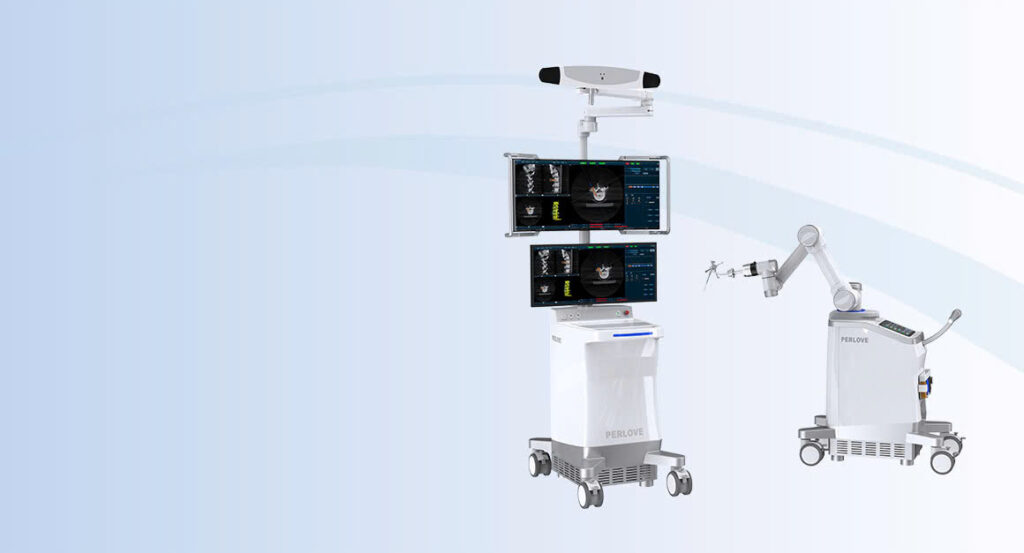
PL300B Spine Surgical Navigation and Positioning System

Hệ thống định vị phẫu thuật

Features & Benefits

Product Description

Adaptive Registration, More Precise

The PL300B was first manufactured in China, integrating a 3D imaging C-arm system during surgery and a spinal surgical navigation system.

The PL300B was independently developed and produced. Integrated with adaptive registration technology, it can automatically register and align the three coordinate systems: optical tracking device, patient, and imaging data.

No manual intervention is required during the registration process, and the accuracy is not affected by image quality. This provides stronger system compatibility, more precise coordination, and more convenient registration, as both the 3D C-arm and the robot are manufactured by a major Chinese company.

Precise Positioning

Intelligent Assistance, Precise Positioning

Equipped with a high-precision optical tracking system and robotic arm, PL300B can guide the surgeon in intraoperative planning and assist in the precise positioning ofimplants or surgicalinstruments based on 3D images and the surgical planning software.The accuracy can reach sub-millimeter level, reaching the international leading level. In particular, it has obvious advantages for high-risk and complex surgeries and can effectively reduce surgical risks.

The orthopedic surgical navigation system can assist in the precise positioning of implants with sub-millimetre accuracy, effectively reducing the occurrence of complications.

Simplification

  • Standard Surgical Workflow

The guidance of the standardized workflow reduces the uncertainty in the surgery, makes the complex surgery workflow simpler, and allows the inexperienced doctors to master it quickly, shortening the learning curve of doctors.

PL300B can be widely used in spine surgery, assistingsurgeons to accurately locate the lesion site and providing intraoperative planning visualized guidance on the position and angle of the implant insertion and simulation of implant insertion for spine surgery (percutaneous vertebroplasty, pedicle screw fixation, etc.)

  • Optimize the Surgical Workflow

Traditional surgeries require multiple manual positions for implant insertion, which is cumbersome. The surgical robot can realize one-time planning of multiple implants, saving planning and positioning time, simplifying surgical steps, and greatlyimproving the efficiencyofimplant placement.

High Efficiency Low Radiation

The average fluoroscopy time for each hollow screw in traditional surgery is 39 seconds. The number of fluoroscopies in robot-assisted surgery is reduced, and the time for screw placement is reduced to 2.3 seconds per screw, which greatly shortens the average surgical time and effectively improves surgical efficiency by 30%.

In robotic-assisted surgery, the fluoroscopic dose, time, and number of the C-arm are significantly reduced compared with traditional surgery, and the radiation damage to the surgeons and the patient is greatly reduced.

Intelligent, Safe, Reliable

  • Multi-angle Rotating Monitor

The monitor can display real-time intraoperative images, support large-angle rotation to meet clinical observation, and facilitate real-time monitoring of the implant position.

Percutaneous Kyphoplasty

Patient Info.: 66 years old, female
Diagnosis: Compression fractures
Procedure: Robotic-assisted percutaneous kyphoplasty

Percutaneous Pedicle Screw Fixation

Patient Info.: 74 years old, female
Diagnosis: Thoracic compression fractures
Procedure: Robotic-assisted percutaneous pedicle screw fixation

Percutaneous Pedicle Screw Fixation

Patient Info.: 22 years old, male
Diagnosis: Lumbar compression fractures
Procedure: Robotic-assisted percutaneous pedicle screw fixation

Bone Biopsy


Patient Info.: 6l years old, female
Diagnosis: Bone tumors, bone destruction
Procedure: Robotic-assisted bone biopsy


Bone Biopsy

Patient Info.: 49 years old, female
Diagnosis: Intra-and extra-vertebral space-occupying lesions
Procedure: Robotic-assisted bone biopsy

Vagus Nerve Stimulation

Patient Info.: 13 years old, male
Diagnosis: Neurogenic bladder
Procedure: Robotic-assisted vagus nerve stimulation

Surgical Toolkit

Consumables

Electric Drill Toolkit

Consumables

Other Tools/Consumables

Leave a Reply

Your email address will not be published. Required fields are marked *